You know that moment when someone texts back “kk” and you’re left staring at your screen, trying to decode if they’re chill or secretly annoyed? Yeah, you’re not alone.
Here’s the deal: kk means okay. That’s it. Two letters doing the work of four, usually sent when someone wants to acknowledge your message without turning it into a whole thing.
But like most things in texting, context is everything.
Where This Confusion Actually Comes From
The weirdness makes sense when you think about it. We’ve all received that single “K” that felt like a verbal slap. So when you see “kk,” your brain might panic—did they just double down on the attitude?
Actually, no. The second K changes everything. It’s like the difference between slamming a door and closing it normally. One K feels abrupt and cold. Two Ks? That’s someone being casual, not combative.
Still, the letters themselves look almost accidental. Like maybe someone’s thumb slipped, or autocorrect had a stroke. That visual strangeness is part of why people second-guess it.
What’s Really Happening When Someone Types KK
Think of kk as the digital equivalent of giving someone a thumbs up across the room. You’re not ignoring them, but you’re also not stopping everything to have a deep discussion about it.
People choose kk instead of spelling out “okay” because:
- It’s genuinely faster to type
- It strips away the formality that “okay” sometimes carries
- It signals “message received” without implying you need to keep talking
- It feels conversational rather than transactional
The emotional temperature? Neutral to warm, depending on your existing relationship. Not enthusiastic, not cold—just there.
Real Situations Where KK Shows Up
Quick confirmations: Your roommate texts “grabbing milk on the way home,” you reply “kk.” Done.
Group chat coordination: Someone suggests a time to meet. Three people respond with “kk” because nobody needs to write an essay about showing up to brunch.
Acknowledging instructions: Your friend explains where they parked. You send “kk” while walking to find them, because you’re literally mid-task.
Ending minor exchanges: After a few messages back and forth about something small, kk becomes the period at the end of the sentence. Conversation complete.
It thrives in low-stakes moments where efficiency beats elaboration.
Read More: What Does FSS Mean in Text? Definition, Examples & When to Use It
When KK Turns Into a Problem
Same two letters, completely different meaning. Watch out for these scenarios:
Someone opens up emotionally, you respond with kk. Congratulations, you just made them feel invisible. This is prime “do you even care” territory.
Professional settings. Your manager assigns you a project and you hit back with “kk”? That reads as either immature or disrespectful, even if you meant well.
After a fight or apology. If your partner says “I’m really sorry about earlier” and you send “kk,” you’ve basically weaponized punctuation. It screams “I’m still mad but don’t want to talk about it.”
Mismatched energy levels. They send you a long, thoughtful message. You reply “kk.” The imbalance speaks volumes—and none of it’s good.
Here’s a red flag worth remembering: when someone who normally texts in complete sentences suddenly drops to “kk,” something shifted. Pay attention to the change, not just the word.
Times You Should Definitely Skip KK
Avoid it when:
Someone shares bad news or personal struggles. Responding with kk makes you look detached at best, heartless at worst.
You’re texting with older relatives or anyone unfamiliar with internet shorthand. They might literally not understand what you mean.
Work emails or messages to teachers, clients, supervisors. Save this for platforms where professionalism isn’t expected.
You want to seem engaged or supportive. KK will never make someone feel valued or heard.
Public comments on social media posts. What feels breezy in private can look dismissive when hundreds of people see it.
Read More: What Does TT Mean in Text? The Real Answer
Better Options That Actually Match the Moment
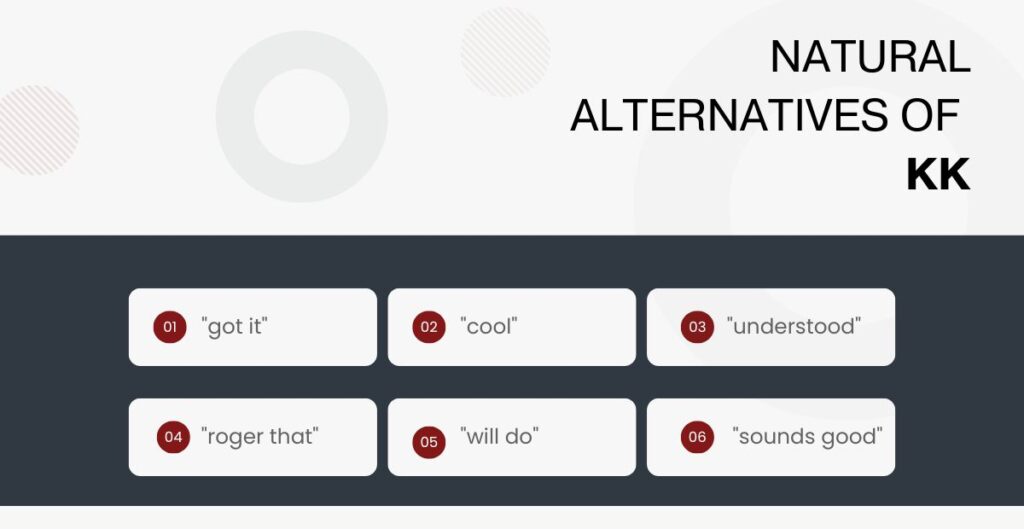
When you want to stay casual:
- “got it”
- “sounds good”
- “perfect”
When professionalism matters:
- “understood, thank you”
- “will do”
- “noted”
When you’re being playful:
- “okayyyy”
- “10-4”
- “you got it boss”
Match your response to both the situation and the person. Your best friend gets different treatment than your department head.
Examples That Make It Click
Scenario 1
Them: “Bring sunscreen tomorrow”
You: “kk”
Works perfectly. Simple instruction, simple response.
Scenario 2
Them: “I’ve been feeling really stressed about this interview”
You: “kk”
Disaster. They needed empathy, you gave them radio silence.
Scenario 3
Gaming chat: “Everyone ready?”
Multiple responses: “kk” “kk” “yep”
Natural habitat for kk. Fast coordination, zero drama.
Scenario 4
Them: “Can’t hang out tonight, family stuff came up”
You: “kk”
Risky. Might seem like you don’t care, even if you’re just being brief.
Scenario 5
Work Slack from colleague you’re friendly with: “Meeting moved to 3pm”
You: “kk thanks”
Borderline acceptable because you added “thanks.” Plain kk would’ve been too casual.
Read Also: What Does JP Mean in Text? The Real Answer Nobody Tells You
Where KK Came From (And Why It Stuck)
Gaming culture basically invented this shorthand back in the early 2000s. Players needed to confirm strategies or acknowledge callouts without taking their hands off the controls for long. Double-tapping K beat typing four letters while someone’s shooting at you.
It spread from MMOs and chat rooms into mainstream texting, carried forward by people who grew up gaming online.
Discord and gaming platforms still use it constantly—it’s muscle memory at this point. But on visual platforms like Instagram or TikTok, you’ll see fewer kks and more emoji reactions instead. Different spaces, different norms.
Generational divide matters here too. Gen Z treats kk as standard vocabulary. Millennials recognize it. Boomers might genuinely ask what you’re trying to say.
Questions People Actually Ask
Does kk sound angrier than okay?
Opposite problem. One K sounds angry. Two Ks soften it into something neutral or friendly. The doubling is intentional damage control.
Can kk be sarcastic?
Absolutely. Send someone a detailed explanation about something and get “kk” in return? That’s sarcasm. Tone comes from context, not the letters themselves.
Why lowercase instead of capitals?
Lowercase feels relaxed. “KK” in all caps can read as shouting or aggressive, which defeats the entire purpose of using it.
Is there a gender difference in meaning?
No. People love to overthink this and assign different intentions based on who’s texting, but kk means the same thing regardless. Don’t invent problems that aren’t there.
What about in work environments?
Depends heavily on your workplace culture. Tech startup with casual Slack channels? Probably fine with teammates. Corporate email to your VP? Absolutely not. When in doubt, add a few more words.
The Bottom Line
KK works beautifully in the right context—quick, casual, efficient. It fails spectacularly when someone needs actual engagement or when professionalism matters.
The trick isn’t avoiding it entirely. It’s recognizing that those two letters carry different weight depending on what came before them, who’s receiving them, and what’s happening between you and that person right now.
Use it with friends making plans. Skip it when emotions are high or stakes matter. And if you’re ever unsure? Adding literally any other word (“kk thanks,” “kk sounds good”) smooths out the potential awkwardness.