You’ve seen PMO pop up in messages and you’re here because context didn’t help. Fair enough—this one’s tricky.
The short version: PMO switches between “Pisses Me Off” and “Put Me On” depending on what’s happening in the conversation. No signal words, no consistent pattern. Just context.
The Two Meanings That Keep Colliding
“Pisses Me Off” is the venting version. Someone’s irritated, fed up, or just done with whatever they’re dealing with. Could be serious frustration or that low-level annoyance that doesn’t deserve a full sentence.
“Put Me On” means hook me up, show me, introduce me. You’re asking someone to share access to something you want—music, places, people, whatever they’ve got that looks good.
Here’s the problem: “you pmo” could mean your friend’s annoyed with you OR they want you to recommend something from your last story. Big difference.
What It Looks Like in Real Conversations
Finals week group chat: “this professor pmo with these due dates”
Under someone’s gym photo: “pmo to your workout routine”
After a retail shift: “entitled customers pmo so bad today”
Gaming lobby: “lag pmo I can’t even move”
Friend sees your new sneakers: “yooo pmo to where you got those”
The pattern? Complaints use it as an exclamation. Requests use it as a verb with “to” following.
Read More: What Does FSS Mean in Text? Definition, Examples & When to Use It
Reading the Room (Because You Have To)
Tone matters more than the letters themselves. Your best friend texting “you pmo 😂” after you send a terrible pun? That’s affectionate roasting. Your roommate texting “you pmo” with no emoji after you ate their leftovers? Actual problem.
Check what you were just discussing. If you posted about a restaurant and someone replies “pmo,” they want the name. If you’re mid-argument and they send it, they’re not asking for recommendations.
Emoji can help but don’t rely on it. Some people never use them.
When This Term Doesn’t Belong
Professional emails, formal chats, serious conversations about real problems—leave PMO out of it. Telling someone “yeah that would pmo too” when they’re genuinely upset reads as dismissive.
Parents, teachers, bosses unless you’re genuinely close. Even then, probably not.
If you’re using it every other message, you’re overplaying it. Everything can’t piss you off all the time, and you can’t need recommendations for everything.
Say It Different
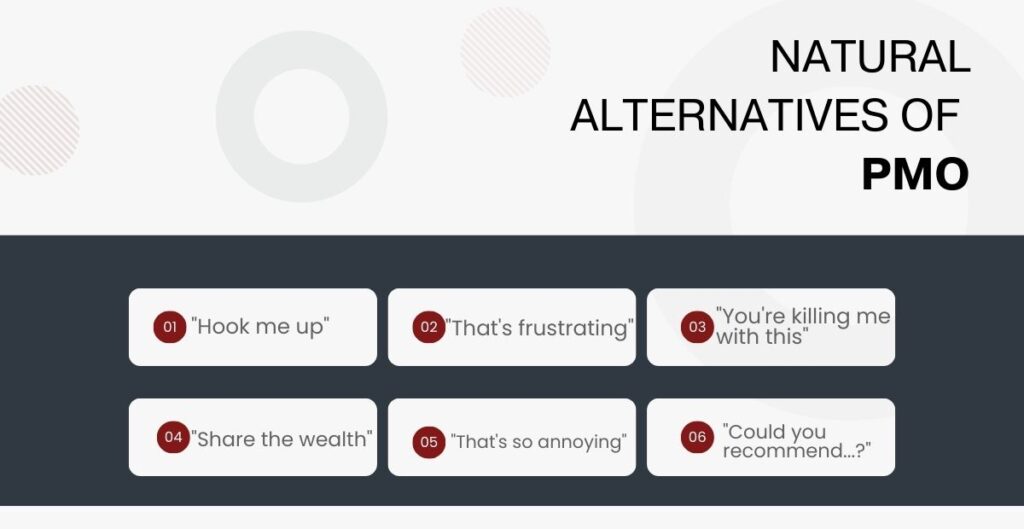
Instead of “that pmo”:
- “That’s annoying as hell”
- “I’m so over this”
- “Getting on my nerves”
Instead of “pmo to that”:
- “Send me that link”
- “Who’s your plug for that?”
- “I need the details on this”
Keeping it polite:
- “That’s really frustrating”
- “Would you mind sharing?”
- “Any chance you could recommend…?”
More Post: What Does K Mean in Text? And Why It Might Sound Rude
Where You’ll See Each Version
TikTok comment sections are complaint central—mostly “Pisses Me Off” under rant videos and relatable content. Instagram DMs lean toward “Put Me On” when people want your sources for outfits, food spots, or whoever you were with in that photo.
Snapchat uses both pretty evenly. Roblox chat? Almost always the angry version because kids complain about literally everything in games.
Younger users (middle school through college) switch between both without thinking. Anyone over 30 might only know PMO as “Project Management Office” from work, which creates genuinely funny confusion sometimes.
The Weird Exceptions
The fitness and self-improvement community has a completely different PMO meaning related to habits people are trying to break. Only relevant if you’re deep in NoFap or similar spaces, but worth knowing so you don’t accidentally reference it wrong.
Some people use “ts pmo” which just means “that shit pisses me off”—same idea, more emphasis.
Don’t confuse it with PM (private message) or DM. Completely different things.
Read More: What Does JP Mean in Text? The Real Answer Nobody Tells You
Quick Answers to Common Questions
Can you use this sarcastically?
Absolutely. “Oh no, my phone’s at 99%, this really pmo” works if you’re making fun of someone being dramatic.
Is there a safer way to ask for clarification?
Just ask. “Wait, are you mad or asking for something?” beats guessing wrong every time.
Does punctuation change the meaning?
Not really. “You pmo” and “you pmo.” mean the same thing—you still need context.
What if someone uses it and I genuinely can’t tell?
Look at the last few messages. If they asked a question, they probably want something. If they’re describing a situation, they’re probably venting.
Bottom Line
PMO doesn’t have training wheels. You can’t learn a formula and apply it everywhere. Every time you see it, you’re doing a split-second calculation based on who’s talking, what came before, and how it feels.
When you’re unsure, ask. “You mad or you want something?” is a perfectly reasonable response. Way better than assuming wrong and either missing out on a good recommendation or not realizing someone’s actually annoyed with you.
The slang works because it’s fast and flexible. The confusion exists because it’s too flexible. That’s texting for you.