PSA stands for “Public Service Announcement” in texting and online messaging. People use it to share something they think everyone needs to know—like a warning, reminder, or (very often) a dramatic opinion dressed up as helpful advice.
Why You’re Probably Confused
You saw someone type “PSA:” in a text or comment and thought, “Wait, isn’t that what the government uses for serious ads?” Yeah, it is. But online, people grabbed that official-sounding acronym and turned it into something way more casual. Now it shows up everywhere from your group chat to TikTok captions. If you’re scratching your head wondering when PSA stopped being serious, you’re not alone.
What It Actually Means in Real Life
When someone drops a PSA in a text, they’re putting on an imaginary megaphone. The term gives your message instant weight—even if what you’re saying is totally trivial.
Here’s the thing: PSA lets you complain, judge, or overshare without sounding whiny. You’re not nagging your roommate about dirty dishes—you’re performing a public service by reminding everyone. It frames personal frustration as community wisdom.
The feeling behind it is usually genuine helpfulness (rare), playful exaggeration (common), or thinly-veiled irritation (very common). Sometimes it’s affectionate, like when your friend warns you about a terrible movie. Other times it’s clearly shade, like when someone posts “PSA: Some people need to learn boundaries” after a fight.
How People Use It in Everyday Situations
In group chats, it’s perfect for announcements that affect everyone: “PSA: I’m bringing my new boyfriend to game night.”
On social media, it works as a caption starter. Someone posts a photo of a restaurant fail with “PSA: Don’t order the salmon here.” It’s half warning, half entertainment.
In direct messages, PSA shows up more ironically. If your friend texts “PSA: I’m gonna be late” it’s usually self-aware humor about their chronic tardiness. They know it’s dramatic to call a normal update a public service announcement. That’s the joke.
Reddit uses it differently—genuinely useful posts like “PSA: The website’s down for maintenance” or “PSA: Scammers are using this new method.” There it’s actually trying to help the community instead of just venting.
More Post: What Does FSS Mean in Text? Definition, Examples & When to Use It
Tone & Context (This Really Matters)
The exact same PSA can sound helpful, annoying, or funny depending on who’s saying it and where. With close friends, “PSA: Stop texting your ex” reads as caring advice. From an acquaintance? Sounds preachy.
Sarcasm is huge with PSA. When someone says “PSA: Water is wet” or “PSA: Mondays still suck,” they’re mocking the format itself.
Here’s where people mess up: using PSA for something genuinely serious. If you text “PSA: My grandma died” it sounds off. The format is so linked to casual or semi-joking content that it clashes with real grief.
If a girl posts “PSA: He’s not worth it” on her story, her friends know exactly who she’s talking about. It’s a subtweet. But to strangers scrolling by, it just looks like generic advice. That double meaning is intentional—she gets to vent publicly while maintaining some deniability.
When You Should NOT Use This Term
Skip PSA in actual emergencies. “PSA: Call 911, someone’s hurt” wastes precious seconds and sounds bizarre.
Don’t use it in professional settings unless your workplace is super casual. An email starting with “PSA: Q4 reports are due Friday” makes you sound like you’re trying too hard to be relatable. Older colleagues might find it unprofessional.
Avoid it in one-on-one serious conversations. If your partner says they need to talk about something important and you respond with “PSA: I’m listening,” it comes across dismissive.
Don’t overuse it in the same group chat. If you’re the person who starts every other message with PSA, people will start tuning you out.
And here’s a big one: don’t use PSA to deliver harsh criticism directly. “PSA: You talk too much” isn’t funny—it’s just mean with extra steps.
Natural Alternatives (Grouped by Tone)
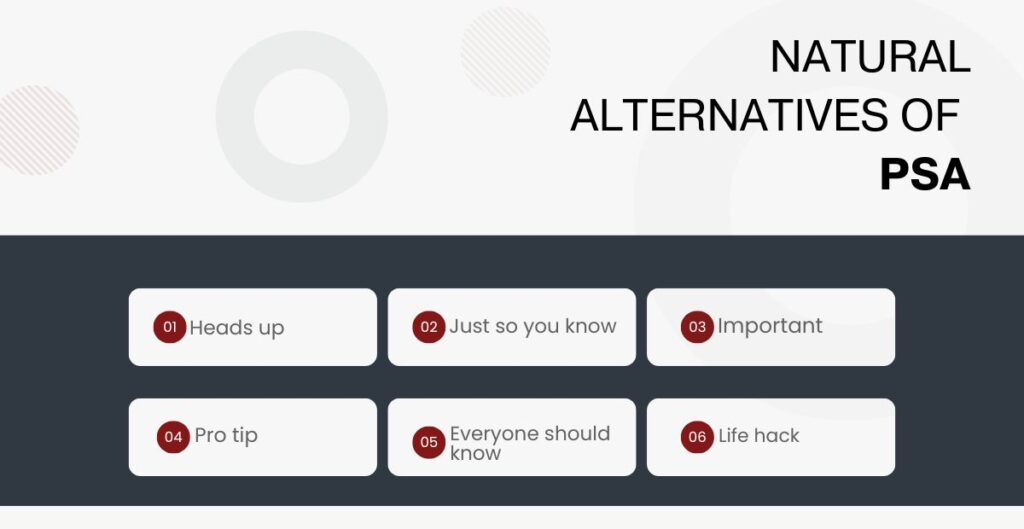
Casual / Friendly:
- Heads up
- Just so you know
- Quick reminder
Direct / Clear:
- Everyone should know
- Important
- Listen up
Playful / Light:
- Fun fact
- Pro tip
- Life hack
Professional:
- Please note
- For your information (FYI)
- Team update
Real-Life Examples
Group Chat Warning: “PSA: Sarah’s bringing her sister to brunch so don’t mention the surprise party”
TikTok Caption: “PSA: This mascara smudges after two hours don’t believe the hype”
Sarcastic Comment: “PSA: Just because you can reply-all doesn’t mean you should”
Relationship Boundary: “PSA: I’m not answering work texts after 8pm anymore”
Reddit Community Help: “PSA: The new update deletes your saved files, back up everything first”
Ironic Self-Awareness: “PSA: I’m having a bad day and will be grumpy, apologies in advance”
Social Media Call-Out: “PSA: if someone leaves you on read for three days they’re not busy they’re not interested”
Friend Group Drama: “PSA: we’re not talking about Jake tonight he’s banned from conversation”
Read More: What Does UWU Mean in Text? The Real Meaning Explained
Platform & Culture Notes
TikTok loves PSA because it fits the “storytime but make it advice” format. Creators frame their personal experience as universal wisdom worth sharing.
Reddit treats PSA more seriously. Subreddits have rules about it—some require mod approval for PSA posts because people were abusing it. There, it’s meant to serve the community, not just be a catchy opener.
Twitter and Instagram stories use PSA for subtweeting. Someone posts “PSA: If they ignore you, they’re showing you who they are” and everyone knows there’s specific drama behind it, even if the poster acts like it’s general advice.
Younger people use it more playfully and sarcastically. Older generations either skip it completely or use it more literally, which creates confusion when they’re texting across age gaps.
Common Misunderstandings
People think PSA always means the person is joking, but sometimes folks are genuinely trying to be helpful and just picked an awkward format. Don’t automatically assume sarcasm—check the context.
Some read PSA as passive-aggressive by default because it’s been overused for venting. Even innocent uses can get misread. If you post “PSA: Library closes early on Saturdays,” someone might think you’re shading people who show up late.
There’s also confusion about who the “public” is. On a private story, PSA feels more like an inside joke. On a public post with thousands of followers, it actually functions closer to its original meaning.
Read Also: What Does TT Mean in Text? The Real Answer
FAQs
Can PSA sound rude or bossy?
Yeah. If you’re not close with someone or the situation is sensitive, PSA can make you sound like you’re lecturing people who didn’t ask for advice.
Is it always sarcastic?
Not always, but it’s often at least a little bit playful. Pure sincerity with PSA is less common unless you’re on Reddit or warning people about something genuinely important.
Do people use it the same way everywhere?
Not really. Reddit’s more serious about it, TikTok’s more dramatic, and in texts it depends on your friend group’s humor style.
What if someone uses PSA in a work email?
It depends on your workplace vibe. Tech startups and creative teams might be fine with it. Corporate offices or formal industries? Probably skip it.
Is there a difference when a girl uses PSA vs when a guy does?
The term itself works the same, but girls on social media tend to use it more for relationship commentary and life updates, while guys lean into the sarcastic “obvious statement” format. That’s not a rule though—just a pattern.
Wrapping This Up
PSA in texting is people borrowing officialness to make their random thoughts feel important. Sometimes it’s genuinely useful, sometimes it’s funny, and sometimes it’s just venting in disguise. Context and tone decide everything. Same three letters, completely different vibes depending on who’s typing and why.