“FR” means “for real” — it’s what you type when you want someone to know you’re being serious, honest, or genuine. It’s like saying “I’m not joking” but way faster.
Why Everyone’s Asking About This
You probably saw “FR” pop up in a text or comment and thought, “Wait, what does that actually mean?” Maybe someone replied to your story with just “FR” and you had no clue if they agreed with you or were asking a question. Or you’ve seen people type “FR FR” and wondered why they said it twice.
What It Actually Means in Real Life
When someone uses “FR,” they’re anchoring the conversation back to reality. Think of it as a reality check in two letters. It’s what people use to cut through jokes or sarcasm and say “okay, but seriously though.”
The feeling behind it is sincerity mixed with urgency. People pick this over typing full sentences because it carries weight without sounding dramatic or awkward.
How People Use It in Everyday Situations
“FR” shows up as a quick response. Someone shares something wild, and you hit them back with “FR?” like you need confirmation they’re not messing with you. Or you’re backing up a friend’s point in a group chat and drop “FR” to show you’re on their side.
You’ll see it tacked onto statements. “That movie was terrible FR” hits different than just “that movie was terrible” because you’re swearing by your opinion.
Some people use it as a standalone reply. Just “FR” in response to someone’s rant means “I hear you, I agree, everything you just said is valid.”
“FR FR” (sometimes “FRFR”) is doubling down. If “FR” is being serious, “FR FR” is taking a digital oath. “I’m never going back there FR FR” means you’ve made a life decision.
Related: What Does HMJ Mean in Text? Real Answer Explained
Tone & Context
“FR” sounds completely different depending on who’s saying it and what’s happening.
Between close friends, it’s supportive. But if you barely know someone and they hit you with “FR?” after every message, it feels like they don’t believe you.
The punctuation matters. “FR?” asks for proof. “FR.” states a fact. “FR!” is excited agreement.
Watch out for sarcasm. Someone posting “I love waking up at 5am FR” is probably not sincere — they’re using the honesty signal to highlight how much they actually hate it.
One warning: if someone keeps responding with only “FR” in a serious conversation, they might be emotionally checking out. It becomes a lazy reply when they don’t know what else to say.
When You Should NOT Use This Term
Don’t use “FR” in work emails. Your manager doesn’t want to see “I’ll finish the report by Friday FR.”
Skip it with teachers, coaches, or anyone’s parents. “Thank you for the recommendation FR” sounds too casual.
Be careful with people who are upset. If someone’s genuinely hurt, hitting them with “FR?” can sound dismissive, like you’re doubting their feelings.
It gets awkward in public comments on sensitive topics. Someone posts about a personal loss and you comment “That’s rough FR” — it might come across as flippant.
Related: IRL Meaning in Text: The Real Answer (Not What You Think)
Natural Alternatives (Grouped by Tone)
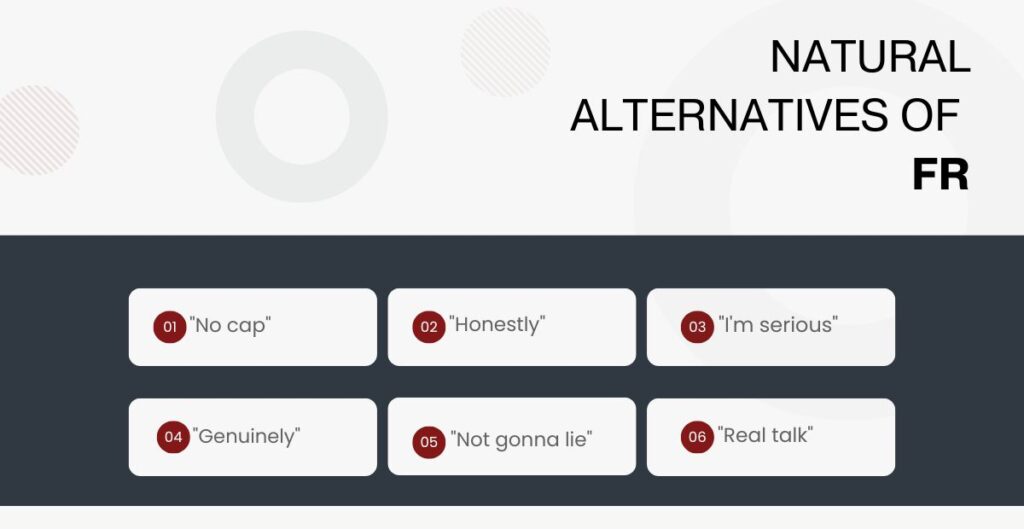
Casual with friends:
- “No cap”
- “Honestly”
- “Deadass”
- “I’m serious”
More polite:
- “Truly”
- “Genuinely”
- “I mean it”
Joking around:
- “Lowkey”
- “Not gonna lie”
- “Real talk”
Real-Life Examples
“Did you really eat the whole pizza?” “FR, I was starving”
“Your hair looks amazing” “FR? Thanks!”
“I’m quitting tomorrow” “FR? What happened?”
“This weather is awful FR”
“Wait you’re moving? FR FR?”
“I can’t believe he said that” “FR, so awkward”
Read More: WBU Meaning in Text: What It Means When Someone Says “WBU”
Platform and Culture Notes
On Instagram, “FR” in comments shows a compliment isn’t just surface-level. “You look good FR” sounds like they actually paid attention versus automatic “nice pic.”
Snapchat uses tend to be spontaneous in quick captions since everything disappears.
In WhatsApp group chats, it works as a planning lock-in. “We’re leaving at 7, FR?” means “I need to know if this is actually happening.”
Younger users sometimes spam it ironically. “I’m fine FR FR FR” with crying emojis is clearly a joke about not being fine.
Guys often use it as an emotional safety net. “I miss hanging out FR” feels less intense than saying it without the “FR.”
Common Misunderstandings
People mix up “FR” with “FR?” One is a statement, the other is a question.
Some think it always means deep seriousness, but “This song slaps FR” isn’t a life-or-death declaration — it’s just emphasis.
Overusing it kills the effect. End every message with “FR” and it stops meaning anything.
Older people sometimes read it as aggressive when it’s not. To them, “FR?” might sound like “are you calling me a liar?”
FAQs
Can you use FR sarcastically?
Yes. “I love cleaning my room FR” when you obviously hate it uses the sincerity marker to highlight the opposite.
Is FR rude to use?
Not between friends, but it can be in formal situations, with strangers, or in sensitive moments.
What if someone just replies “FR” to everything?
They’re either really agreeing, or on autopilot and not fully engaged. Context makes it obvious which one.
Is “FR FR” different from “FR”?
Yes — it’s stronger. You use it when regular “FR” doesn’t feel like enough.
Wrapping Up
“FR” looks simple but does a lot of work in conversations. It keeps things feeling real when everything online can sound fake. Just know when a situation needs actual words instead of shortcuts.
More English Articles: